Re_Connection

Our intention

Our intention

In many social, ecological and cultural contexts, people encounter exhaustion, tension and a sense of being overwhelmed. Questions of engagement, belonging and focus touch on concrete action, on emotions and on bodily experience. This is where Re_Connection begins: as a structured frame in which bodily attention, shared reflection and movement come together to meet open questions collectively — without therapeutic promises and without a predetermined outcome. Our approach invites participants to observe how personal experience and social realities interact, and how the force of community can open up perspectives that are hard to reach in everyday life.

During the darkest days of the AIDS crisis we buried our friends in the morning, we protested in the afternoon, and we danced all night, and it was the dance that kept us in the fight because it was the dance we were fighting for.

– Dan Savage

Foundations

Four pillars

Re_Connection draws on approaches from several fields and combines them into a form of its own.

Somatic and movement-based approaches

Body and emotions condition one another. Findings from neurophysiology feed into the approach. Through Carolina's expertise we make particular use of elements from dance and movement therapy to strengthen the group, to sharpen perception and to explore the respective topics individually.

Dialogic and reflective methods

A wide range of methods from transformative education supports the cognitive engagement with the topics. We are especially shaped by the spiral of active hope after Joanna Macy: gratitude, honouring our pain, seeing with new eyes, and going forth into action.

Ecological and relational perspectives

Knowledge about the structural and individual conditions of our feeling and acting is what distinguishes this approach from many mindfulness practices. Engaging with ecological and social facts from a human-rights perspective forms the basis for the social-scientific and philosophical encounter. Ways of relating are the starting point of our thinking.

Ritual, music and temporal structure

Live music as a sensory element supporting each process provides the foundation. Grounded in a critical ethnological and musicological engagement with ritual practices, it serves as a temporal scaffolding, marking transitions and the different stages in the process of reflecting on each topic.

Perspectives

What inspires us

Our work is strongly shaped by the deep ecologist Joanna Macy and her approach Work that Reconnects. We find further answers in Greek and Roman, Eastern and contemporary philosophy, in social science, in approaches from dance therapy, in musicology and in ritual theory. The following people inspire us particularly often, or lastingly:

  • Joanna Macy
  • Byung-Chul Han
  • Ursula K. Le Guin
  • Hannah Arendt
  • Donna Haraway
  • Erich Fromm
  • Bini Adamczak
  • Hartmut Rosa
  • Audre Lorde
  • bell hooks
  • Robin Wall Kimmerer
  • Ram Adhar Mall
  • Peter Sloterdijk
  • Rudolf von Laban
  • Leor Zmigrod
  • Jonathan Lear

… and many more, and new people all the time. In doing so we try to keep a power-critical perspective on our influences, and we know that we have blind spots. Thank you for your thoughts!

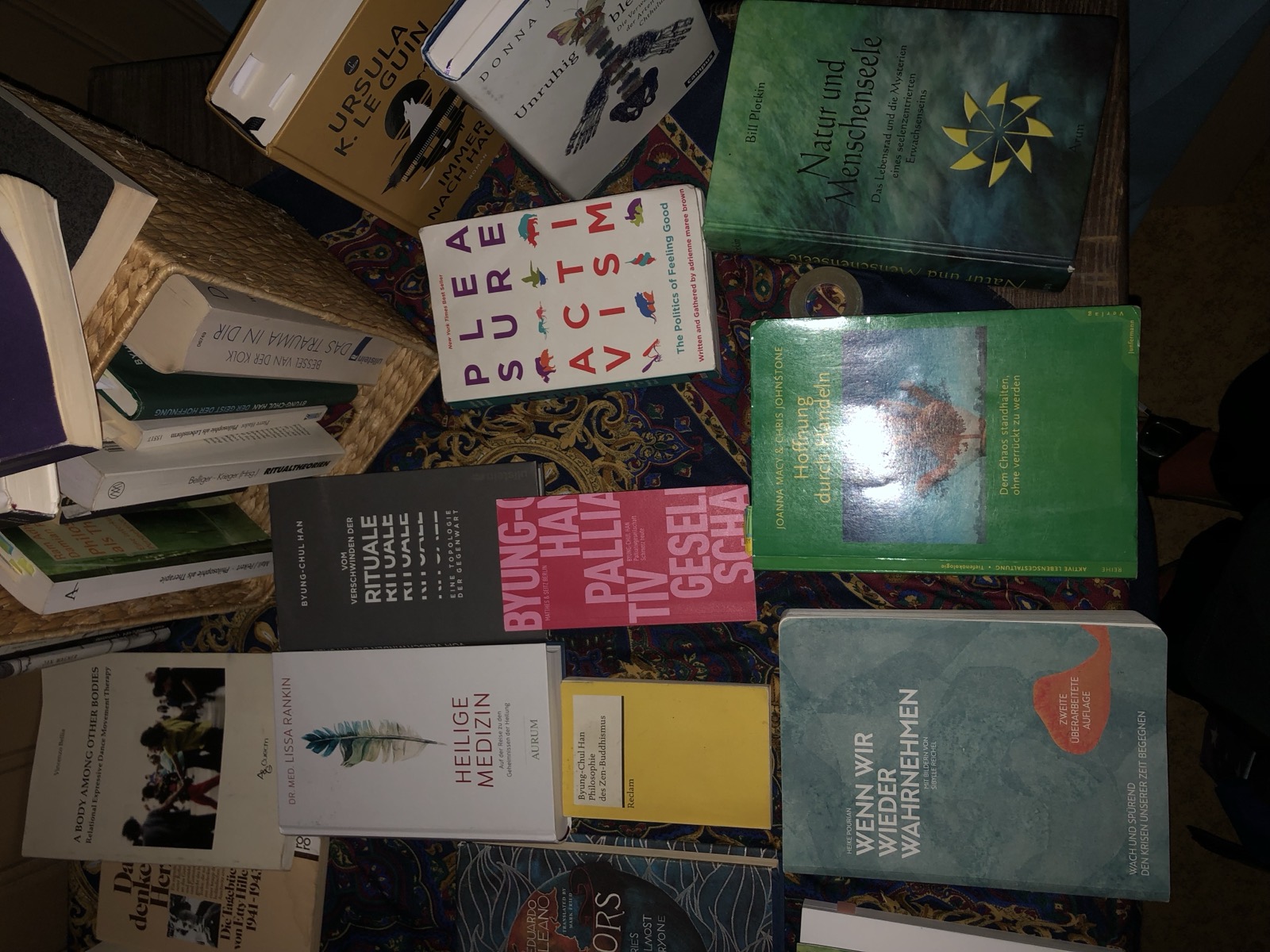
A stack of books from the working library, including titles on ritual, hope and civic education
From the team's working library

Perspectives

Research & collaboration

Re_Connection is a practice that touches on a great many fields. We welcome exchange with academic institutions and with people working in similar ways.

We can imagine accompanying research, evaluation designs, case studies or joint funding applications — for example in the fields of democratic education, dance and music studies, ritual studies or transformation research.

We invite interested universities and institutes to talk with us about possible forms of exchange and collaboration.

Research or funding partnership

If you are interested in academic accompaniment, evaluation or a joint application, we would be very glad to hear from you.

Background: in a research project of his own, Arystan Petzold explores how ritual spaces come into being and how they can be shaped responsibly — more on this at arystan.de (in German).